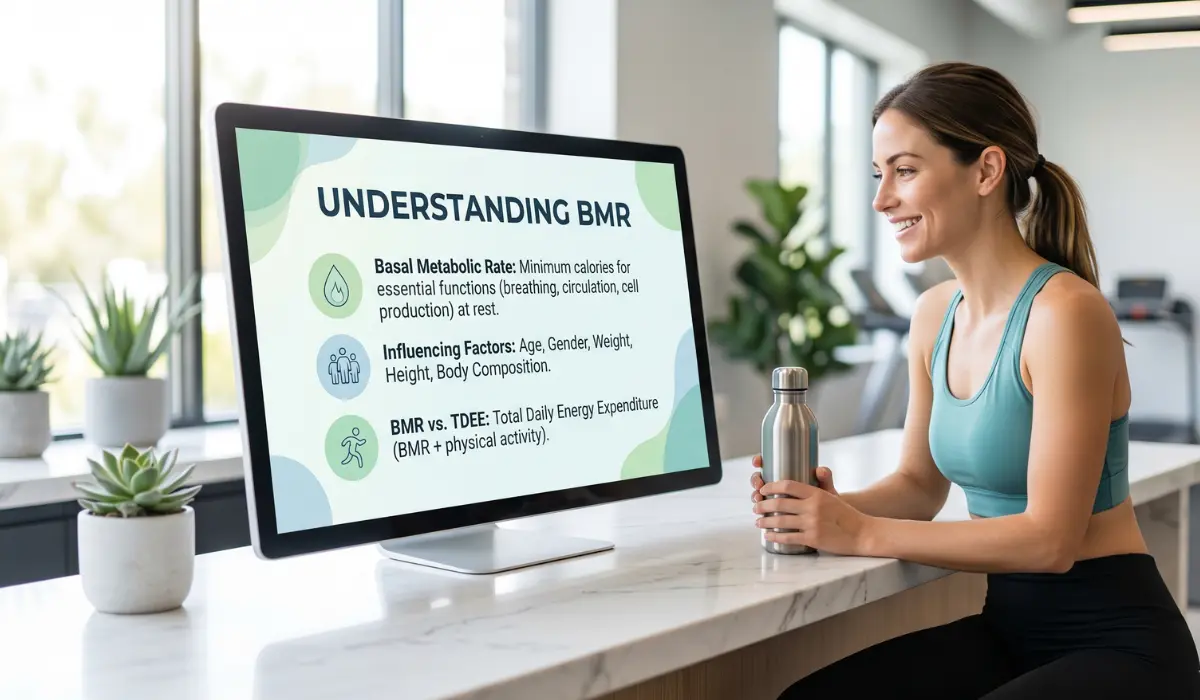
Have you ever wondered how many calories you would burn if you spent an entire 24 hours just lying in bed, not moving a single muscle? That number isn't zero. In fact, for most of us, that number represents the vast majority of the energy we use every day. This is your Basal Metabolic Rate (BMR).
What is BMR, Really?
Think of your body like a car. Even when the car is parked and idling in the driveway, it’s still burning fuel to keep the engine warm and the electronics running. Your BMR is your "idling speed." It is the energy required to keep your heart beating, your lungs breathing, your kidneys filtering, and your brain functioning.
For the average person, BMR accounts for about 60% to 75% of their total daily energy expenditure. It’s the "cost of living" for your cells.
BMR vs. RMR: What’s the difference?
You might see these terms used interchangeably, but they are slightly different. BMR is measured under very strict laboratory conditions (usually after 12 hours of fasting and 8 hours of sleep). RMR (Resting Metabolic Rate) is a more "real-world" measurement taken while you are awake and resting. For most home users, the difference is negligible, but our calculator uses the most accurate standard formulas to give you a reliable estimate.
Why BMR is the Key to Weight Loss
Most people make the mistake of focusing only on the calories they burn at the gym. While exercise is great, it’s a small piece of the pie. If you want to lose weight effectively, you have to understand your BMR first.
If you eat fewer calories than your BMR plus your activity level, you will lose weight. However, if you drop your calories below your BMR for too long, your body might go into "starvation mode," slowing down your heart rate and energy levels to protect itself. This is why "crash diets" almost always fail in the long run.
Factors That Influence Your BMR
Everyone’s engine idles at a different speed. Here is why:
- Muscle Mass: This is the big one. Muscle is metabolically active. It takes more energy to maintain muscle than fat. The more muscle you have, the higher your BMR.
- Age: As we get older, we tend to lose muscle mass, and our metabolic processes slow down slightly. This is why it’s "harder" to stay thin as you age.
- Gender: Generally, men have a higher BMR than women because they typically have a higher percentage of lean muscle mass.
- Genetics and Health: Things like thyroid function and your genetic blueprint play a role in how fast or slow your internal engine runs.
Can You "Speed Up" Your BMR?
The short answer is yes! While you can't change your age or genetics, you have significant control over your metabolism. Here is how advanced learners approach it:
1. Resistance Training
Lifting weights is the most effective way to raise your BMR. By adding just a few pounds of muscle to your frame, you increase the amount of fuel your body burns every minute of the day, even while you sleep.
2. Protein Intake
The body uses more energy to digest protein than it does to digest fats or carbohydrates. This is known as the Thermic Effect of Food (TEF). A high-protein diet slightly nudges your resting metabolism upward.
3. Sleep and Hydration
Your metabolic processes require water to function. Dehydration can slow down your BMR. Similarly, lack of sleep disrupts hormones like cortisol and insulin, which can lead to a "sluggish" metabolism.
Putting Data into Action
Knowing your BMR is the first step toward freedom from "guessing" your diet. Instead of following a random 1,200-calorie diet you found online, use our BMR Calculator to find your specific number. Once you have that baseline, you can add your activity level to find your TDEE and set a goal that actually works for your unique body.
Final Thoughts
Your metabolism isn't a fixed number; it’s a living, breathing system. By understanding your BMR, you stop fighting against your body and start working with it. Eat to fuel your engine, move to strengthen it, and use data to guide you.