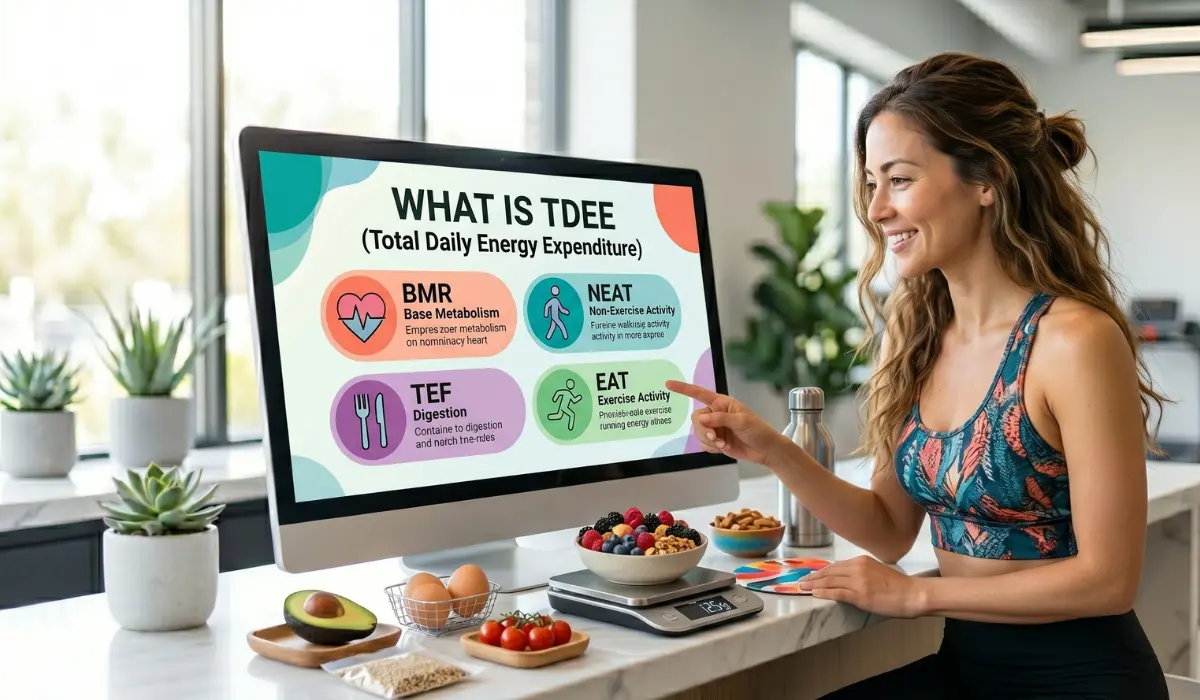
If you’ve been following our series, you now know about calories, BMR, and macronutrients. But how do they all fit together? The answer lies in your Total Daily Energy Expenditure (TDEE). This is the absolute total of calories your body burns in a single day.
The Four Pillars of TDEE
Your TDEE isn't just one number; it's a combination of four distinct metabolic processes. Understanding these helps you realize that you have more control over your metabolism than you think.
How TDEE is Calculated
To find your TDEE, we take your BMR and multiply it by an "Activity Factor." This factor accounts for how much you move throughout the day. This is why our FitMeter Calculator asks for your activity level—it's the only way to get a truly personalized result.
The Activity Multipliers:
- Sedentary (1.2): Little to no exercise, desk job.
- Lightly Active (1.375): Light exercise 1-3 days a week.
- Moderately Active (1.55): Moderate exercise 3-5 days a week.
- Very Active (1.725): Hard exercise 6-7 days a week.
Ready to find your number?
Use our precision tool to get your results in seconds.
Go to TDEE CalculatorWhy Your TDEE is a Moving Target
One of the biggest mistakes people make is assuming their TDEE stays the same forever. In reality, it changes constantly. If you lose weight, your TDEE goes down because a smaller body requires less energy. If you gain muscle, your TDEE goes up because muscle is metabolically expensive to maintain.
This is why we recommend recalculating your TDEE every time you lose or gain 5kg of body weight.
How to Use TDEE for Your Goals
Once you have your TDEE from the FitMeter homepage, you can set your path:
- For Fat Loss: Eat 500 calories below your TDEE.
- For Muscle Gain: Eat 300 calories above your TDEE.
- For Maintenance: Eat exactly your TDEE.
The Secret Weapon: NEAT
Most people focus on "EAT" (the gym), but as you can see from the breakdown above, "NEAT" (daily movement like walking or cleaning) actually burns significantly more energy over the course of a week. If you want to raise your TDEE without spending more time at the gym, simply move more in your daily life. Take the stairs, walk while on the phone, and stand instead of sitting.
Conclusion
Understanding TDEE is like having the keys to your body's energy kingdom. It removes the mystery from weight management and puts the power back in your hands. You aren't "broken," and your metabolism isn't "slow" but you just need to align your intake with your expenditure.
Thank you for following our health series! We hope these guides, combined with our calculator tools, help you achieve the healthy lifestyle you deserve.